UFC Odds Accuracy: Historical Win Rates and Pricing Edges
 Available in US
I have a table pinned above my desk. It contains one dataset: historical win rates by odds band for UFC fights from April 2013 to November 2022. I glance at it before placing every bet, because it answers the single most important question in sports betting – how accurate are the prices I am betting into?
The answer is nuanced. Bookmakers are impressively calibrated at the extremes and surprisingly loose in the middle. Understanding exactly where the pricing breaks down gives you a map of where the exploitable edges live, and that map does not change as quickly as you might think.
UFC Accuracy by Odds Band and Favourite Win Rates
The dataset covers nearly a decade of UFC results, and the patterns within it are remarkably stable. At the heavy favourite end of the spectrum, UFC odds priced between -400 and -900 have delivered an 88-93% win rate since 2013. That range corresponds to implied probabilities of roughly 80-90%, meaning the bookmakers are pricing these fighters very close to their true probability of winning. The vig inflates the price slightly above fair value, but the underlying calibration is strong. If you are betting heavy UFC favourites, you are betting into an efficient market where the margin for error is thin and the bookmaker’s pricing is difficult to beat.
The picture changes dramatically as the odds move toward even money. Fights priced between +100 and -122 – essentially coin-flip territory – have landed at only 51% for the favoured fighter. That 51% figure is remarkably close to a literal coin flip, which means the bookmaker is telling you the fight is too close to call, and the historical record confirms that assessment. The difference between 51% and 50% is statistically insignificant over any reasonable sample size. For bettors, this range is the most dangerous one to bet blindly in and the most rewarding one to bet selectively in. When your analysis identifies a genuine edge in a coin-flip fight – a stance mismatch, a camp change, a stylistic kryptonite that the market has not priced – the payoff is substantial because the base odds are close to even money.
The middle bands – favourites priced between -150 and -350 – show the most interesting pricing behaviour. This is where the majority of UFC bets are placed, and where the calibration is good but not as tight as at the extremes. Favourites in this range win at rates that slightly underperform their implied probabilities, which means the bookmaker is pricing in a modest favourite bias from casual bettors. The public likes favourites, and bookmakers shade their lines to accommodate that preference. The result is that underdogs in the corresponding range – roughly +130 to +300 – are slightly underpriced over large samples.
That underpricing is not dramatic enough to make blind underdog betting profitable after vig, but it does mean that when your analysis points to an underdog in this range, the market is working in your favour rather than against you. Favourites win 65-70% of UFC bouts overall, but within the -150 to -350 band, the win rate is closer to 63-67%, and the gap between implied and actual probability is where disciplined bettors find value.
Has Odds Calibration Changed Over Time? 2013-2025 Analysis
One question I get asked regularly is whether bookmaker pricing has improved over time as more data and better models have become available. The answer is yes, but not uniformly across all markets.
The moneyline market – the primary market for UFC betting – has tightened meaningfully since 2013. Early in the dataset, the gap between implied probability and actual win rate was larger across all odds bands. By 2020, the calibration at the extremes had improved to near-perfect levels, and the middle bands had tightened as well. This makes sense: bookmakers invested in MMA-specific trading teams, historical data accumulated, and the growing handle attracted sharper bettors whose activity improved price discovery.
The improvement has been less pronounced on prop markets, round bets, and live betting. These markets are newer, carry less volume, and are modelled with less granular data. The pricing accuracy on a method-of-victory prop in 2025 is roughly where the moneyline calibration was in 2016 – functional but loose. That historical lag is an opportunity for anyone willing to apply the same analytical rigour to props that the broader market applied to moneylines a decade ago.
The trend has implications for strategy. If you are primarily a moneyline bettor, your edge is shrinking as the market matures. The edges are migrating toward the markets where calibration has not yet caught up – props, round bets, live markets. Adapting to that migration is not optional; it is the difference between a bettor who remains profitable and one who watches their edge erode while continuing to bet the same markets the same way.
Where Bookmaker Pricing Breaks Down: Exploitable Ranges
After years of tracking my own results against odds bands, I have identified three specific ranges where bookmaker pricing is most consistently exploitable.
The first is the moderate underdog range: +150 to +250. Fighters priced in this band win more often than their implied probability suggests, particularly when they possess specific profile characteristics – high finish rates, southpaw stances, or recent camp changes. The market underprices these fighters because casual bettors instinctively back favourites, and the bookmaker accommodates that bias by shading the line. My tracked sample shows a positive return on investment for selectively backed underdogs in this range, though the variance is high and the results require patience over hundreds of bets.
The second is the heavy favourite prop market. When a -300 or -400 favourite is priced for a specific method of victory – say, “by KO/TKO” at 2.10 – the bookmaker is pricing the method independently of the moneyline. But the two are not independent in reality. A heavy favourite with an 80% win probability and a 60% career finish rate should be priced at roughly 1.67 for a KO/TKO win (0.80 x 0.60 = 0.48, implied odds 2.08). When the prop is priced above that calculation, there is an edge; when it is priced below, there is not. The market frequently misprices this because the moneyline and prop trading desks do not always coordinate perfectly.
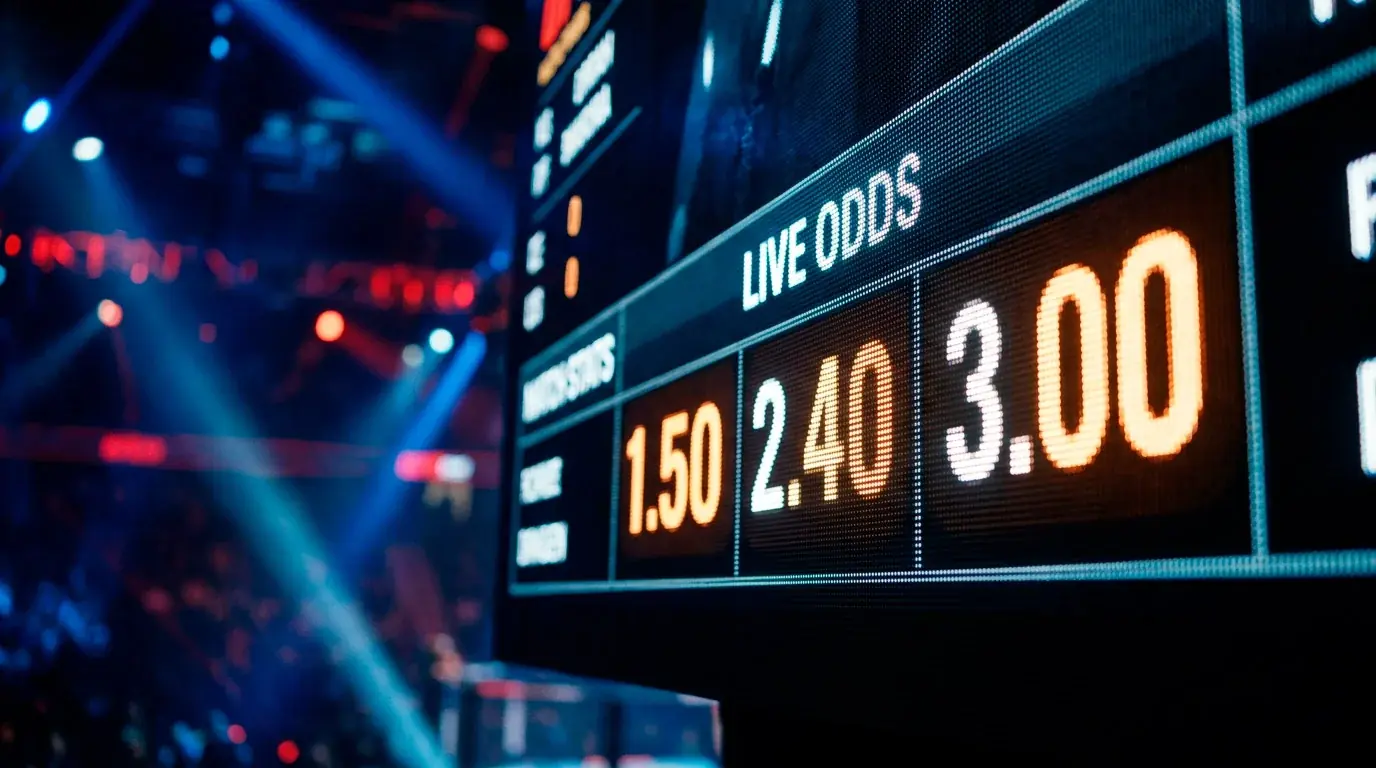
The third is the live market during the first round. Live odds overreact to early action – a fighter who lands a clean shot in the opening minute sees his live odds shorten dramatically, even if the shot did not significantly damage his opponent. The live pricing algorithm treats visible action as a proxy for fight control, which is often correct but sometimes wildly misleading. A fighter who absorbs a clean shot but remains defensively sound is often underpriced in the live market for the next thirty seconds, creating a window that rewards quick, informed action.
For a complete walkthrough of how to convert odds into implied probabilities and use those calculations to identify value, the full UFC odds explained guide covers the mathematical framework in practical detail.
What is the win rate for heavy UFC favourites priced at -400 or shorter?
UFC fighters priced between -400 and -900 have won 88-93% of the time since 2013, closely matching their implied probabilities. This range represents the most efficiently priced segment of UFC betting markets, where the bookmaker’s calibration is strong and the margin for finding value is thin.
Are UFC odds more or less accurate than in team sports?
UFC moneyline odds have become increasingly accurate over the past decade but remain slightly less calibrated than odds for major team sports like football, where larger samples and deeper liquidity produce tighter pricing. The gap is most pronounced in UFC prop markets, round bets, and live betting, which carry wider margins and less refined models than equivalent team-sport markets.
Prepared by the ufc Betting Trends editorial staff.