UFC Line Movement Analysis: Tracking Odds Shifts and Steam
 Available in US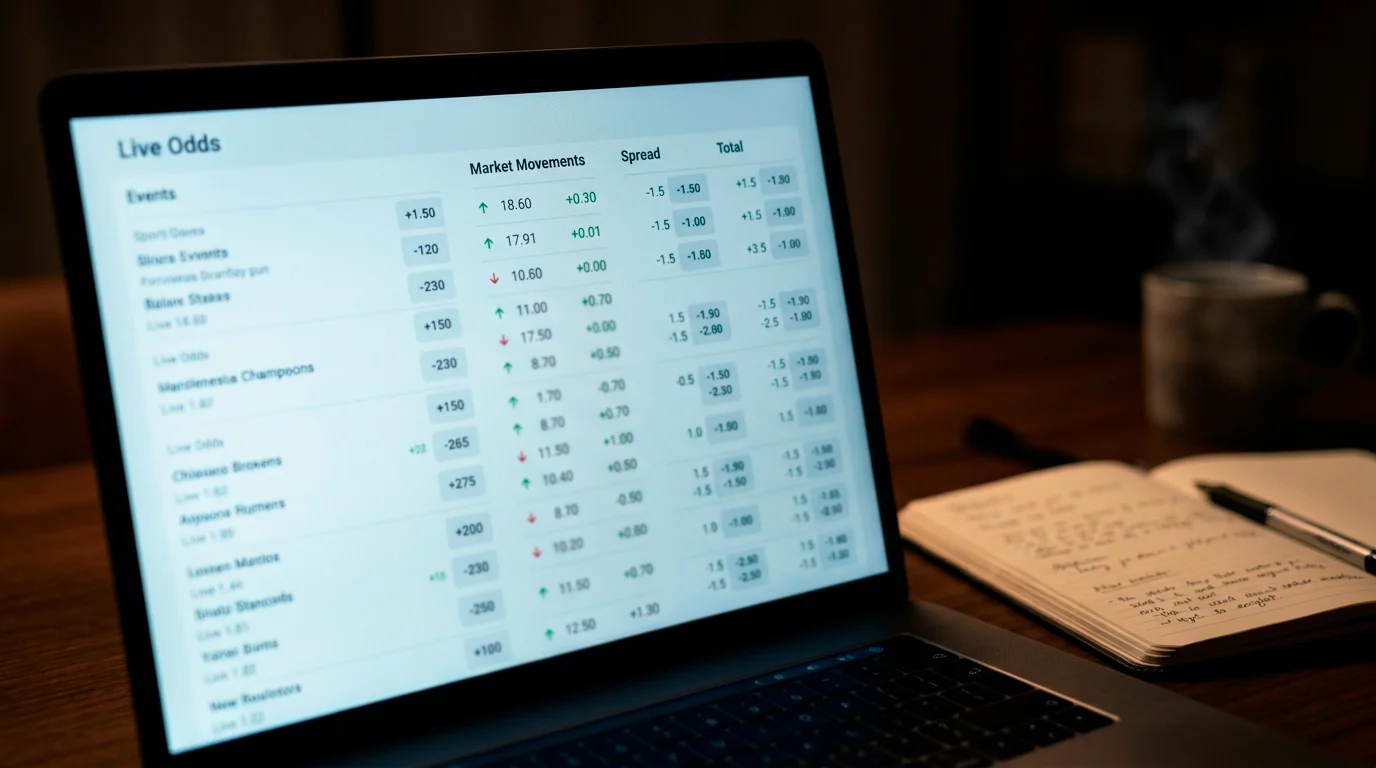
I keep a spreadsheet that tracks every UFC opening line against its closing price, and after three years of data the patterns are unmistakable. The gap between where a line opens and where it closes tells you more about a fight’s true probability than either number does alone. Learning to read that movement — and more importantly, learning to act on it before the window shuts — is one of the most transferable skills in combat sports betting.
Line movement in UFC is not like football or basketball. The markets are thinner, the information asymmetries are wider, and a single sharp bettor can move a line in ways that would take thousands of casual bets to replicate in a Premier League match. That creates both opportunity and noise, and separating the two is what this piece is about.
Tracking UFC Line Movement and Odds Shifts
The first thing I tell anyone who asks about line movement is to stop looking at a single snapshot. A line at -180 tells you almost nothing. A line that opened at -140 and moved to -180 tells you a story — someone with conviction and capital has backed that fighter, and the bookmaker has adjusted to manage its liability.
Tracking tools that overlay opening and closing lines for UFC fights are available through several odds-comparison platforms. I use two simultaneously, because no single source captures every bookmaker’s opening price. The key metrics I monitor are the opening line, the line at 48 hours before the fight, the line at weigh-in time, and the closing line. Those four snapshots create a movement arc that reveals when information entered the market and how aggressively it was acted upon.
The direction of movement matters, but so does the velocity. A line that drifts from -140 to -155 over five days is absorbing public money — the market is adjusting gradually as casual bettors pile on. A line that jumps from -140 to -180 in six hours, especially mid-week when public volume is low, signals sharp action. That distinction is critical because the two types of movement have different predictive value. Sharp moves correlate with better outcomes than gradual public drift, which is why I weight sudden mid-week movements more heavily in my pre-fight assessment.
Ali Schempp, the SVP and Head of Business Development at US Integrity, has observed that more betting offered on the UFC means more bookmakers get comfortable putting up new markets and expanding the menu. That expansion creates more data points for tracking movement — but it also means that movement on the moneyline and movement on props can tell different stories about the same fight. I always check whether the moneyline movement is consistent with the over/under and method-of-victory movements. When they diverge, something interesting is happening.
Weigh-In Windows: When 23% of Main-Event Lines Flip
If there is one number from my tracking that changed my approach to UFC betting more than any other, it is this: underdogs flip to favourites in 23% of main events inside 48 hours of weigh-ins. Nearly a quarter of headline fights see their lines cross zero in the final two days before the bout. That is an extraordinary rate of reversal for any sport, and it is driven almost entirely by information that becomes available at or after the weigh-in.
The weigh-in is the single most information-dense moment in the UFC fight cycle. Both fighters step on the scale, and the public sees their physical condition for the first time. A fighter who looks drawn, gaunt, or physically diminished after a hard weight cut sends a visible signal that correlates with diminished performance. Conversely, a fighter who makes weight comfortably and looks healthy provides reassurance. These visual cues are not precise, but they are real, and sharp bettors have learned to act on them quickly.
Beyond the visual, the weigh-in period is when late-breaking news tends to surface — training camp injuries, coaching changes, personal issues. Fighters and their teams manage information carefully in the weeks before a fight, but the final 48 hours are when leaks occur and when official announcements about fight-week issues become unavoidable. A fighter revealing a hand injury at the press conference the day before the fight will move a line instantly.
For practical betting, the weigh-in window is where I make the majority of my final adjustments. I set my initial positions based on my model’s output — usually three to five days before the fight — and then revisit them after the weigh-in. If the line has moved in the direction my model predicted, I hold. If it has moved against me, I re-examine whether the new information justifies the movement or whether the market is overreacting. That discipline — having a pre-set position and then evaluating new information against it rather than reacting emotionally — is what separates systematic betting from gambling.
Reverse Line Movement: When Public and Sharp Money Disagree
Last year I spotted a reverse line movement pattern on a co-main event that paid handsomely. The public was flooding in on Fighter A, pushing his line from -150 to -170. But the line snapped back to -145 by close, despite continued public betting on Fighter A. That reversal meant the bookmaker was taking large enough positions on Fighter B to offset the public volume — a textbook signal of sharp money on the underdog. Fighter B won in the second round.
Reverse line movement occurs when the line moves in the opposite direction to where the majority of public bets are being placed. In a normal market, more bets on one side push the line in that direction. When the line moves the other way, it means the money on the less popular side is larger per bet, even if fewer bets have been placed. That is the signature of sharp action — professional bettors placing significant stakes on the side the public is ignoring.
UFC odds priced between +100 and -122 have historically landed at only 51%, making them essentially coin-flip territory. Reverse line movement in this range is particularly meaningful because the market is uncertain and the sharp money can represent genuine edge rather than noise. When the public pushes a coin-flip fight to -140 and the line snaps back to -115, the sharps are telling you the fight is closer to a toss-up than the public believes. Betting the side of the reversal at -115 gives you a better price than you would have received at the opening.
Not all reverse movements are reliable signals. False reversals occur when a bookmaker adjusts to manage liability rather than responding to informed money — sometimes the book simply needs to balance its exposure and moves the line artificially. I filter for reliability by checking whether the reversal appears across multiple bookmakers simultaneously. If three or four books all move in the same unexpected direction, it is almost certainly sharp action. If only one book adjusts, it is more likely a liability management play specific to that operator.
For a deeper understanding of how to convert these signals into actual bet selections, the complete UFC odds explained guide walks through implied probability calculations that let you quantify whether a line movement represents genuine value or just market noise.
What causes late line movement in UFC fights?
Late movement is driven primarily by information released during the weigh-in window — visual signs of hard weight cuts, injury disclosures, coaching changes, and late-breaking news. Sharp bettors act on this information quickly, moving lines in the final 48 hours before the fight. In 23% of UFC main events, underdogs flip to favourites within this period.
Is reverse line movement a reliable signal for UFC bets?
Reverse line movement is a useful signal but not infallible. It is most reliable when it appears across multiple bookmakers simultaneously, indicating broad sharp action rather than a single operator managing liability. In coin-flip fights priced near even money, reverse movements carry stronger predictive value because the market uncertainty creates more room for informed money to express genuine edge.
Created by the ”ufc Betting Trends” editorial team.